Custom RAG development
A RAG chatbot for your internal documents that cites its sources
Your team asks questions in plain English and gets answers drawn from your own documents, with a link to the passage behind each answer. I build the whole system: ingestion, permissions, retrieval, the chat interface and the server it runs on.
Fixed quote after a free scoping call
A good fit if
- Your team keeps answering the same questions from policies, docs, tickets or contracts
- Your documents are spread across drives, wikis and databases, and finding things takes too long
- People need answers they can check, not confident guesses
- Different people should see different documents
Probably not a fit if
- You only need a chatbot on your public website. The $300 support chatbot fits better
- You want a general assistant with no connection to your data
- You can't share sample documents or real questions during scoping
How I build a document Q&A system
Each part below is agreed in the written scope, so you know what you're getting before work starts.
01Ingestion
I connect the sources named in your scope: uploaded files, Google Drive, Dropbox, a wiki or a database. Documents are parsed, split into passages and indexed. Changed files are re-indexed on a schedule, so answers stay current without processing everything again.
02Data boundaries and permissions
We decide up front what the system may read and who can see what. Access rules are applied when passages are retrieved, before anything reaches the model, so an answer can't draw on a document the person couldn't open. I'll tell you which model providers see your text, and we can use self-hosted models when text can't leave your servers.
03Retrieval choices
Retrieval is tuned for your documents rather than left at defaults: how passages are split, whether keyword search is combined with vector search, how many passages the model sees and whether a re-ranking step is worth its cost. These choices are tested against your evaluation set, not guessed.
04Source citations
Every answer links to the passages it used, so people can check it in seconds. When retrieval finds nothing relevant, the system is built to say it doesn't know rather than answer from general knowledge.
05Evaluation
Before launch, we build a test set from questions your team really asks, with the expected source for each. I run it after every change to retrieval or prompts and share the results: which questions pass, which fail and why. The test set is yours to keep using.
06Hosting options
Your cloud account (AWS, Azure or GCP), a server you own, or inside an app you already run. The usual stack is a FastAPI backend in Python with PostgreSQL and pgvector, or a dedicated vector database such as Qdrant when the document count calls for it.
SaaS/AI
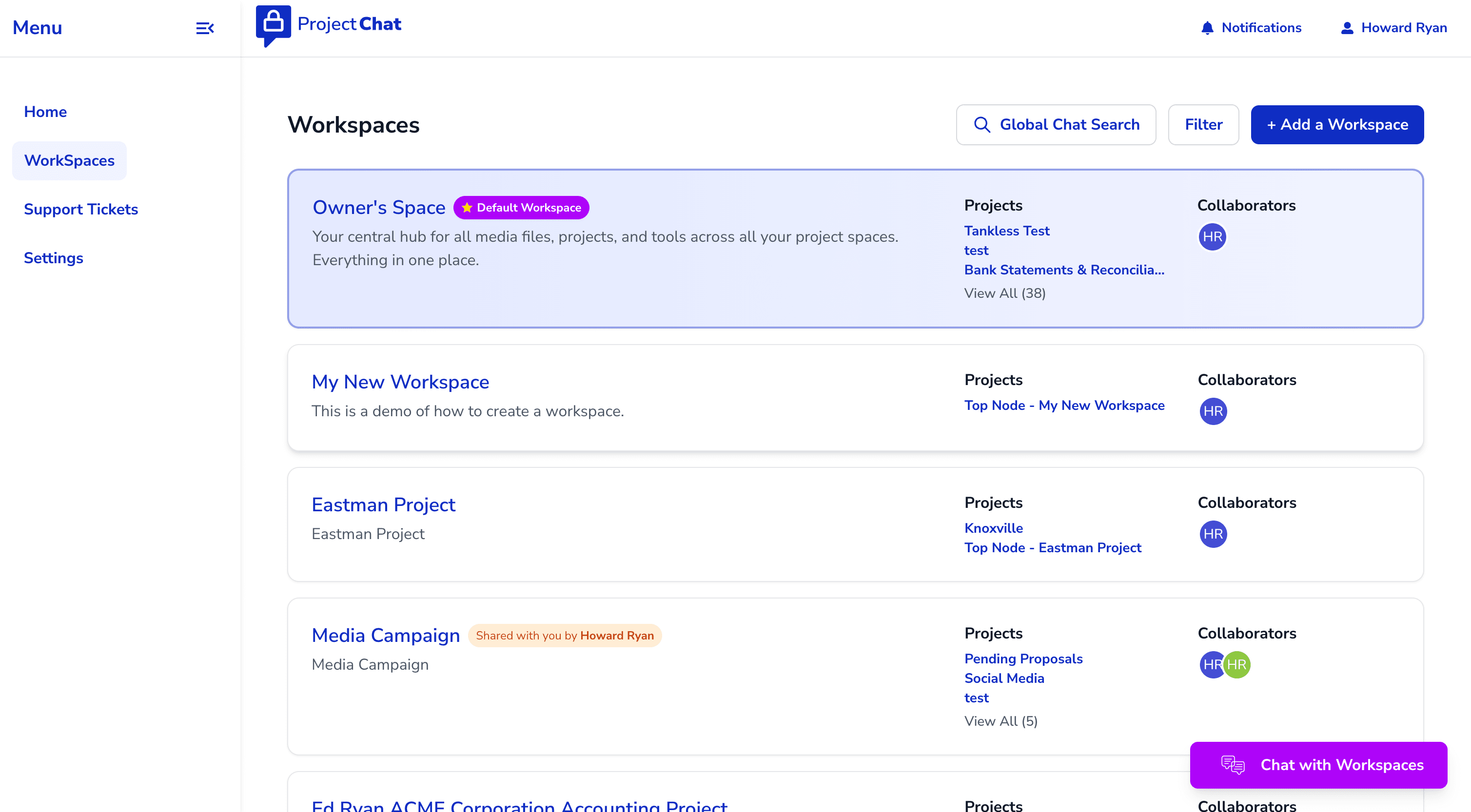
Built before: Project Chat AI
- A workspace for each project, with the documents that workspace should answer from
- Documents come in by upload or from connected Google Drive and Dropbox accounts
- A RAG pipeline finds the relevant passages before the model responds
- One question can go to several models at once to compare their answers
- Python, FastAPI and Django backend, React and Next.js interface, PostgreSQL, with GPT-4 and custom fine-tuned models served with vLLM
“Muhammad delivered an exceptional work! Excellent communication, and always making sure that you're happy with the final work.”

Howard Ryan
CEO, ProjectChat
What you pay for
Building it and running it are separate costs. You get both in writing before work starts.
Fixed quote after a free scoping call
- Ingestion from files, drives, wikis or databases
- Access rules when different people should see different documents
- Source citations on every answer
- An evaluation set built from your real questions
- Deployment to your cloud or a server you own
- You pay providers directly
- AI model API usage, billed to your own account
- Hosting and vector database fees, paid to the provider directly
- Not included
- Data sources not named in the written scope
- Model fine-tuning or self-hosted GPU models, quoted separately
- After launch
- Bug fixes for 14 days. After that, changes are quoted, or you can hire me monthly.
- BuildMe, one time
- A fixed quote after a free scoping call. It depends on the number and type of sources, the permission rules, the integrations and where people will ask questions (a web app, Slack or inside your product).
- Model usageYour AI provider
- Billed to your own account per token. It grows with the number of questions and how much text each answer reads.
- HostingYour hosting provider
- The API server and vector storage. Often fits on infrastructure you already pay for.
- Ongoing workMe, optional
- Bug fixes are covered for the support window. After that, changes are quoted, or you can hire me monthly from $1,500.
How we'll work
You work with me directly from the first call to handover. No account managers, no hand-offs.
01
Free scoping call
30 minutes on what you need, your data and what a good result looks like.
02
Written scope and quote
What's included, what isn't, running costs and the support window, in writing before work starts.
03
Working demo early
You see it working on your own data early and can steer before the rest is built.
04
Build, test, deploy
I build the app and its infrastructure, test it and deploy it to your accounts.
05
Handover and support
Code, documentation and a walkthrough, then bug fixes for the support window.
Questions
How is this different from your $300 chatbot?
The chatbot answers public questions from your website content and collects leads. Custom RAG development is for internal documents: more sources, access rules, citations, an evaluation set and hosting on your infrastructure.
Can it run without sending our documents to OpenAI?
Yes. Open models can run on your own servers. I've served models with vLLM for Project Chat AI. Expect higher hosting costs and some quality tradeoffs, which we'd measure with the evaluation set before you decide.
What should I prepare for the scoping call?
A few sample documents, 20 to 50 real questions your team asks, and a rough idea of who should be able to see what.
Who owns the code?
You do. The code goes into your repository and the system runs on accounts you control.
Do you work as a FastAPI RAG developer inside an existing product?
Yes. If you already have a Python backend, the RAG service can be added to it as its own FastAPI module or service, and your existing authentication can decide what each user may see.
Related guides
How Much Does a Custom RAG System Cost to Build and Run?
What drives the cost of building a custom RAG system, how to estimate monthly running costs from token volumes, and three worked scenarios with every assumption written down.
How to Hire an AI Developer: A Checklist for Startups and Small Teams
How to evaluate an independent AI developer: a scoping checklist, questions to ask, what to check in the code at handover, an evaluation plan and a delivery process that protects you.
Tell me about your project
A 30-minute call is enough to tell whether this fits and what it would cost. You'll get the scope and quote in writing afterwards.